
Walk through a mall this weekend and many storefronts say the same thing: a number with a percent sign. DLF Retail expects double-digit footfall growth over a regular weekend and an estimated 15 to 20% rise in sales across its retail partners.[1] In Ludhiana, Nexus MBD Neopolis runs a four-day sale with up to 50% off across brands from Lifestyle to Sephora.[2]
Footfall is only half the picture. A mall activation earns its space by giving shoppers a reason to stop, try and choose that a discount sign cannot give. Shoppers are choosier than the footfall suggests: TRA Research's October buying intent index fell 3.96%, its steepest monthly fall in 18 months.[3]
This post is for brand managers booking mall space for the next few weeks. It covers where the sale crowd is, what to build, when to run it and how to measure it. The short answer: a mall activation works this season when it gives shoppers a reason to try, choose and come back that a discount cannot, and when you plan it across five sale windows, from the Black Friday weekend to January's sales, not one weekend.
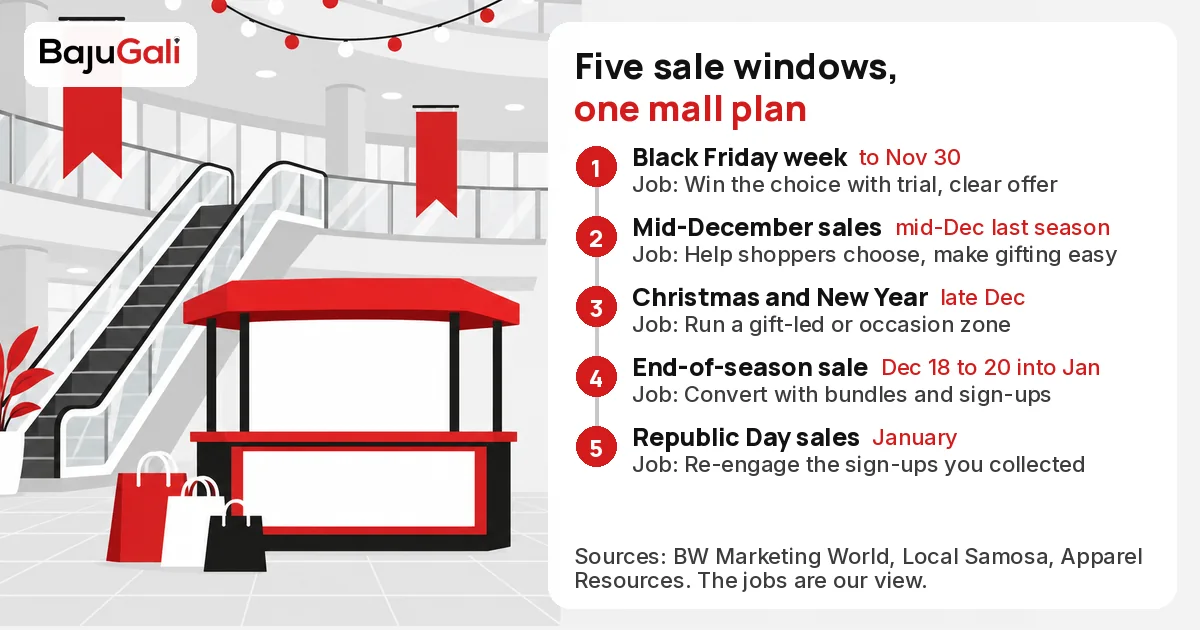
Table of Contents
- Black Friday in India has become a mall weekend, not just an app sale
- A bigger sale crowd is expected, but it is choosier and may be borrowed from December
- Give shoppers a reason to stop beyond the discount
- Plan for tier-2 malls too, because sale shoppers are not only in metros
- Plan five sale windows, not one weekend
- Count the lift over a normal weekend, because the crowd comes anyway
- How we would plan your year-end mall activation
- Before the Christmas crowd arrives
- Frequently asked questions
- References
Black Friday in India Has Become a Mall Weekend, Not Just an App Sale
Black Friday now matters to malls, not only to apps. The weekend has become an important sales window for shopping malls across India, and at some properties it accounts for as much as 30% of monthly store sales.[4] Store sales could rise 15 to 20% in the Black Friday period, with footfall rising significantly.[4] These are mall operators' forecasts made before the weekend, not results.
In India, the event was largely driven by e-commerce and is now extending into retail stores, in a quarter that is a high-investment period for apparel, fashion and beauty.[5] DLF sees shoppers still valuing in-store experiences alongside offers at its malls, and fashion, beauty, footwear, jewelry and watches, and electronics are expected to sell strongly.[1]
Brands are following the shopper into the store. M&S India runs a flat 40% off select products online and in stores, and Birkenstock pairs online discounts with spend-based offers across its stores.[1] Oberoi Mall saw strong traction last year in department stores, apparel and footwear, and a wider range of brands is taking part across Oberoi Mall and Sky City Mall this year.[3]
For a brand manager, the crowd is now a given. What is open is what your brand does with it. Put the Black Friday weekend into your retail marketing calendar as a mall moment, and shortlist malls by the categories that sell there.
A Bigger Sale Crowd Is Expected, but It Is Choosier and May Be Borrowed From December
A bigger crowd does not mean a bigger buyer. TRA Research's buying intent index fell 3.96% month on month to 94.31 in October, and intent dropped in 19 of 29 super-categories.[3] The index measures intent, not sales.[3]
Some of the spend may also be borrowed. Zippee's founder argues that shoppers who planned to buy in December may simply buy earlier, and that the real test is whether November and December together grow.[3] The sales data available today cannot tell new demand from purchases brought forward.[6]
In a sale week your activation competes with every discount sign in the mall. Its job is to win the choice, so give shoppers something other than the price. Before you book space, write down the activation's one job: trial, upgrade, new customers or sign-ups.
Give Shoppers a Reason to Stop Beyond the Discount
Discount signs all look alike, so an activation has to offer what a sign cannot: a chance to try, see, sample or get help choosing. The COO of Dentsu Creative Isobar argues that India needs "a reason to care" about a sale, and that trial-led offers, smart bundling and multi-buy deals for everyday products can beat blanket discounts.[6]
Look at what brands are offering this week. UNIQLO gives a tumbler on a single purchase of Rs 8,000 or more, online and in stores, from November 27 to December 3.[7] Shoppers Stop takes a flat Rs 600 off in stores, and H&M gives members early access from 6 PM.[7] M&S uses its loyalty program to give members early access through its app.[3]
Payment offers now sit beside price cuts. Croma's sale combines exchange offers, bank cashback and financing.[1] Decathlon pairs a bank EMI offer with cuts of up to 40%, online and in stores.[7] A booth that walks shoppers through the offer in plain words can help the shopper decide faster.
These are price and loyalty mechanics. An activation brings what a shelf cannot. The table shows five formats that fit a sale week. The jobs and measures are our own view.
| Format | Job in a sale week | What to count | Where it fits |
|---|---|---|---|
| Sampling counter | Let shoppers try before they choose | Samples given, trials followed by a purchase | Near your store or a busy walkway |
| Demo kiosk | Show the product working | Demos run, sign-ups | Atrium or main walkway |
| Styling or fitting zone | Help shoppers choose | Visits, bills raised | Outside your store |
| Loyalty sign-up booth | Collect opt-ins for follow-up | Sign-ups with consent | Entrance or escalator landing |
| Gift redemption desk | Turn a purchase into a gift | Bills shown, gifts issued | Close to the cash counters |
Pick one format for each job, and keep the mechanic simple enough for a crowded weekend. If a shopper cannot understand it at a glance, cut a step. For formats that have worked in malls, see our live brand activation examples.
Plan for Tier-2 Malls Too, Because Sale Shoppers Are Not Only in Metros
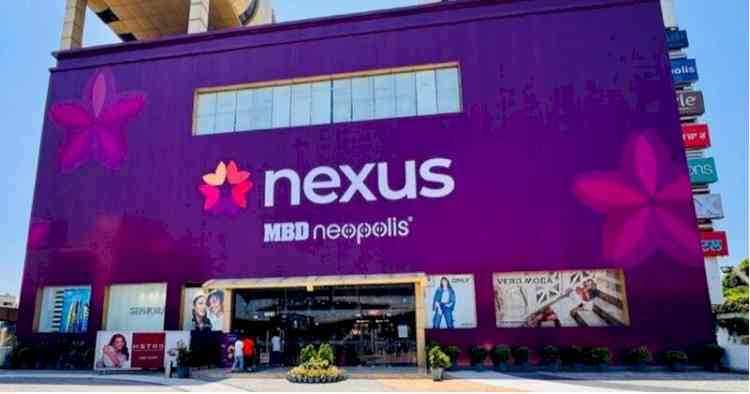
Image: City Air News. Click to read the full report.
Sale demand is not only a metro story, and online data hints at it. On Unicommerce's platform, Tier-3 cities made up 37% of Black Friday 2025 order volumes, against 40% for Tier-1 and 23% for Tier-2.[8] These are online orders on one platform, so they hint at demand but say nothing about mall visits.
Take one smaller-city example. Nexus MBD Neopolis in Ludhiana has a Black Friday sale from November 27 to 30, with up to 50% off across fashion, footwear, beauty, electronics and accessories.[2] Brands in the sale include Lifestyle, Max, Pantaloons, Sephora and Nykaa.[2] The release names no in-mall events, and that is the gap a brand activation can fill.
In our view, a tier-2 mall is a good place to test an activation before you scale it. The stakes are lower, and the lessons carry over. Ask the mall which anchor stores and categories draw its Black Friday crowd, and match your format to them. Add one or two tier-2 malls to your plan, and pair them with hyperlocal product sampling in the surrounding neighborhoods.
Plan Five Sale Windows, Not One Weekend
The sale season runs well past the Black Friday weekend, so a single booking misses most of it. Black Friday itself has grown from a promotion of two to three days into a week-long event.[8] This year's brand windows are November 19 to 30 at Tata CLiQ, November 21 to 27 at Flipkart and November 26 to 30 at Croma.[1]
Year-end sales came early last season. H&M, UNIQLO, Levi's, M&S and Lifestyle began year-end promotions as early as mid-December, almost two weeks ahead of the usual calendar and soon after Black Friday.[9] January's Republic Day sales are a key window to clear winter stock.[9] End-of-season sales typically run from about December 18 to 20 into January.[10]
The calendar can also shift. In 2024, mall administrators asked retailers to postpone early sales, because malls often earn on revenue-share models with their stores.[10] M&S India's managing director places Black Friday alongside Christmas, gifting and New Year.[3] Treat it as one season.
The table sets out the five windows and the job we would give an activation in each. Timings come from the reports above; what shoppers are doing and the jobs are our own view.
| Window | Typical timing | What shoppers are doing | Job for the activation |
|---|---|---|---|
| Black Friday week | About November 19 to 30 this year, varies by brand[1][7] | Hunting deals, buying early | Win the choice with trial and a clear offer |
| Mid-December year-end sales | From mid-December last season[9] | Buying winter wear and gifts | Help shoppers choose and make gifting easy |
| Christmas and New Year | Late December and January 1 | Gifting and occasion shopping | Run a gift-led or occasion zone |
| End-of-season sale | About December 18 to 20 into January[10] | Hunting bargains on clearance stock | Convert with bundles and sign-ups |
| Republic Day sales | January[9] | Buying the last discounted winter stock | Re-engage the sign-ups you collected |
Book mall slots, fabrication and promoters for the whole run now, and reuse one structure across all five windows. Ask each mall for its sale dates in writing, because they can move.
Count the Lift Over a Normal Weekend, Because the Crowd Comes Anyway
Footfall rises on a sale weekend whatever you do, so footfall alone tells you little. The mall forecast in the introduction is double-digit footfall growth over a regular weekend.[1] An activation has to be judged against what would have happened anyway. Conversion rate, repeat purchase, retention and lifetime value show whether a sale-season buyer was worth winning.[5]
Basket size is worth tracking too. Across the festive window, average order value on GoKwik's network was about Rs 1,536, against Rs 1,348 in a normal period, nearly 14% higher.[5] That figure covers the whole festive window, not Black Friday alone, and it comes from one company's network, not from malls. It shows why bill value, not only bill count, belongs on your sheet.
Check December as well. Sales data cannot yet separate new demand from purchases pulled forward, so a strong November proves little until the next month's repeat sales are in.[6] For a sense of a normal month, RAI's September survey put retail sales growth at 8% year on year, with like-for-like sales up 7%.[11] That is a different measure from mall forecasts, so use it only for scale. Smaller cities need their own baseline, because like-for-like retail spending in Tier 3 cities grew faster than in Tier 1 in July, August and September, at 8.0%, 11.9% and 8.6% against 6.5%, 7.6% and 7.1%.[12]
Set up the measurement before you go live:
- Set the baseline. Take footfall and sales from two normal weekends in the same mall.
- Give every activation a code or sign-up. A redemption code or a consented sign-up links the booth to the bill.
- Compare like with like. Compare stores in the same mall with and without the activation.
- Return in January. Count repeat purchases from the people you signed up.
- Agree who reads the numbers. Settle the sheet with your sales team and the mall before the weekend starts.
How We Would Plan Your Year-End Mall Activation
This is how we would plan a mall activation with you across the five windows, using our mall and retail activations:
- 1. Write the one job. Pick trial, upgrade, new customers or sign-ups, and drop the rest.
- 2. Shortlist malls by category and tier. Choose malls where your category sells, and add one or two tier-2 malls as a test.
- 3. Book the whole run early. Ask each mall for approvals, slots and sale dates in writing, for all five windows.
- 4. Build for crowds. We would fabricate one modular kiosk or pop-up structure that sets up fast and moves between malls.
- 5. Brief the promoters. Give each a short pitch and one clear offer, so the answer is the same at every shift.
- 6. Capture opt-ins with consent. Use them for December and January follow-up.
- 7. Measure against a normal weekend. Read the lift, then reuse the structure for Christmas, end-of-season and Republic Day.
Before the Christmas Crowd Arrives
The next few weeks will show whether the Black Friday forecasts held. The early start to year-end sales may repeat this December, as it did last season, so dates can move.[9] Whatever happens, shoppers will keep comparing offers. Watch for two signals in December: real Black Friday results, and whether malls again ask stores to hold back early sales, as they did in 2024.[10]
So act now. Lock your December and January mall slots before the year-end sales start. If you can book only one slot, book the one that lets you collect sign-ups, because they carry your work into January.
Plan Your Year-End Mall Activation With BajuGali
If you are planning mall activations for the year-end sale season, BajuGali plans and runs on-ground brand activations across malls, stores, gated communities and street markets, and builds activation kiosks, stalls and pop-up structures. Talk to our team about your malls, dates and goals and we will help you shape the plan.
Plan Your Mall ActivationFrequently Asked Questions
What is a mall activation?
A mall activation is a brand setup inside a shopping mall, such as a kiosk, sampling counter, demo zone or pop-up, staffed to engage shoppers where they already are. It usually aims at trial, sign-ups or sales in nearby stores, and it works best when it has one clear job.
Does Black Friday matter for physical stores in India?
Yes. Malls now treat the weekend as a major sales window and expect higher footfall, with fashion, beauty, footwear and electronics expected to sell well. Results vary by mall and category, and shoppers are choosier than the crowd suggests, so brands do better when they give shoppers a reason to stop beyond the discount.
When should brands book year-end mall activations?
Book now. The sale season runs from the Black Friday weekend through mid-December year-end sales, Christmas and New Year, end-of-season sales and January's Republic Day sales. Good mall slots, approvals and fabrication need lead time, and sale dates can move, so ask each mall for its calendar in writing.
How do you measure a mall activation in a sale week?
Measure against a normal-weekend baseline, because footfall rises on a sale weekend anyway. Use redemption codes, consented sign-ups, trial counts and repeat purchases, and compare stores in the same mall with and without the activation. Check December and January sales too, since some spend may be pulled forward.
What is an in-store activation?
An in-store activation is a brand promotion inside a retail store, such as sampling, a demo, a display or a promoter-led offer, aimed at shoppers close to the point of purchase. A mall activation usually sits in a common area instead, and draws shoppers toward several stores.
References
- [1] BW Marketing World, Black Friday Is 'Friday-ing' Its Way Into India's Festive Calendar, November 27, 2026.
- [2] City Air News (Nexus Select Malls release), Nexus MBD Neopolis turns Black Friday into the ultimate shopping experience, November 27, 2026.
- [3] Storyboard18, Black Friday 2026: Premiumisation takes centre stage as orders expected to grow 29%, November 27, 2026.
- [4] Mint, Black Friday is here, and it's no longer just a discount weekend for India's malls, November 25, 2026.
- [5] Storyboard18, Festive carts swell 14% as Black Friday gives brands another shot at India's shopper, November 27, 2026.
- [6] BestMediaInfo, Black Friday or just another Friday with bigger discounts?, November 27, 2026.
- [7] Local Samosa, Black Friday Deals 2026: How India Shops and What Brands are Offering New, November 26, 2026.
- [8] MediaBrief (Unicommerce data release), FMCG (+83%), beauty (+77%) and home (+63%) drive India's Black Friday 2025 e-commerce growth: Unicommerce, December 1, 2025.
- [9] Apparel Resources, Apparel Brands Advance Year-End Festival Sales Amid Slow Winter Wear Demand, January 5, 2026.
- [10] Apparel Resources India, Mall operators urge retailers to postpone end-of-season sales, December 13, 2024.
- [11] Retailers Association of India (RAI), RAI Business Survey, Round 75, September 2026, September 2026 data.
- [12] Retailers Association of India (RAI) and Innoviti Technologies, Retail Spending Grows 7.1% in July, 9.6% in August as Tier 3 Cities Outperform Metros: RAI-Innoviti Report (SANKET report, Q2 FY27, as reported by Textile Value Chain), October 27, 2026.
Related Reading
- Brand Activation in India: 4 Live Examples and What They Teach
- Wedding Season Marketing in 2026: BTL Ideas for 52 Lakh Weddings
- Experiential Marketing in India: What Airbnb's Raichand House Teaches Your Next Activation
Facts about brands, malls and sales come from the reports listed in References, and the planning advice is our own view as an on-ground BTL team. The 2026 Black Friday sales and footfall figures are forecasts made before the weekend, and BajuGali did not work on any campaign described here.
Last Updated: November 28, 2026
Share
Trending Topics
-
 November 24, 2026
Concert Marketing in India: How Brands Turn Live Music Into BTL
-
 November 21, 2026
Wedding Season Marketing in 2026: BTL Ideas for 52 Lakh Weddings
-
 November 19, 2026
GTA 6 Marketing: How Rockstar Turned Real Cities Into Vice City
-
 November 17, 2026
Chhath Puja Marketing in 2026: How Brands Took BTL to the Ghats
-
 November 15, 2026
Brand Activation in India: 4 Live Examples and What They Teach
-
 February 13, 2026
ATL vs BTL vs Digital Advertising Explained for Smart Budget Allocation
-
 February 07, 2026
What Is BTL Marketing in 2026? Formats That Drive Results
Siddharth Prasad
A detail-obsessed operator with a sharp execution mindset, driving consistency, coordination, and on-ground excellence across complex business workflows.