
In today’s fragmented media landscape, brands face a crucial question. Where should marketing budgets go? Television and mass media. On ground activations. Or performance driven online campaigns.
The debate around ATL advertising, BTL Advertising, and Digital Advertising is no longer about which channel is better. It is about which channel is right for a specific objective, audience, and growth stage.
Businesses that understand how these three approaches work individually and together gain a significant competitive edge. Those that do not often waste budgets chasing visibility without measurable returns.
This article breaks down the differences, ideal use cases, integration strategies, and common mistakes in choosing between ATL advertising, BTL Advertising, and Digital Advertising.
Understanding ATL, BTL, and Digital Advertising
To make the right decision, you must first understand what each channel represents.
ATL advertising refers to Above The Line communication. It focuses on mass reach through channels such as television, radio, newspapers, cinema, and large format outdoor media. The goal is broad awareness and brand recall.
BTL Advertising refers to Below The Line activities. These are targeted, on ground, and activation driven efforts such as events, retail branding, society campaigns, kiosks, sampling, and direct engagement programs. The focus is interaction and localized influence.
Digital Advertising involves online platforms such as search engines, social media, display networks, video platforms, and programmatic ecosystems. It is data driven, measurable, and highly performance oriented.
Each approach serves a different purpose in the marketing ecosystem.
Core differences explained simply
The simplest way to differentiate ATL advertising, BTL Advertising, and Digital Advertising is through three dimensions: reach, targeting, and measurability.
ATL advertising delivers mass reach. A television commercial or prime time radio spot reaches millions simultaneously. However, measurement is often indirect and brand lift focused.
BTL Advertising delivers physical engagement. It may not reach millions in a day, but it creates deeper brand interaction in specific geographies or communities.
Digital Advertising delivers precision targeting and real time analytics. Campaigns can be optimized instantly based on performance metrics such as clicks, conversions, and cost per acquisition.
In essence:
- ATL advertising builds fame
- BTL Advertising builds engagement
- Digital Advertising builds measurable action
Smart brands rarely choose only one. They design the mix strategically.
Where Each Channel Works Best
Marketing effectiveness depends on aligning the channel with the objective.
When a new brand enters a market, mass awareness becomes critical. ATL advertising works well here. Large scale campaigns build credibility and trust quickly.
When a brand wants to penetrate specific neighborhoods, campuses, residential communities, or retail clusters, BTL Advertising becomes powerful. Face to face engagement drives stronger recall and localized trust.
When a brand wants measurable conversions, retargeting, and data driven optimization, Digital Advertising delivers unmatched efficiency.
But effectiveness also depends on funnel stage.
Funnel-stage mapping
Understanding the marketing funnel helps determine where ATL advertising, BTL Advertising, and Digital Advertising fit best.
Top of Funnel: Awareness
ATL advertising performs strongly at the awareness stage. A well produced television campaign or impactful billboard generates immediate visibility.
Digital Advertising also supports awareness through video ads, display campaigns, and social reach strategies.
Middle of Funnel: Consideration
BTL Advertising shines here. Sampling, mall activations, and experiential events allow potential customers to physically interact with the product.
Digital Advertising supports consideration through remarketing, educational content, and influencer collaborations.
Bottom of Funnel: Conversion
Digital Advertising dominates this stage. Performance campaigns on search and social platforms can directly drive leads and purchases.
BTL Advertising can also support conversion through in store promotions and hyperlocal offers.
ATL advertising at this stage plays more of a reinforcement role rather than direct conversion.
When mapped properly, the funnel shows that no single channel owns the entire journey.
Combining ATL + BTL + Digital
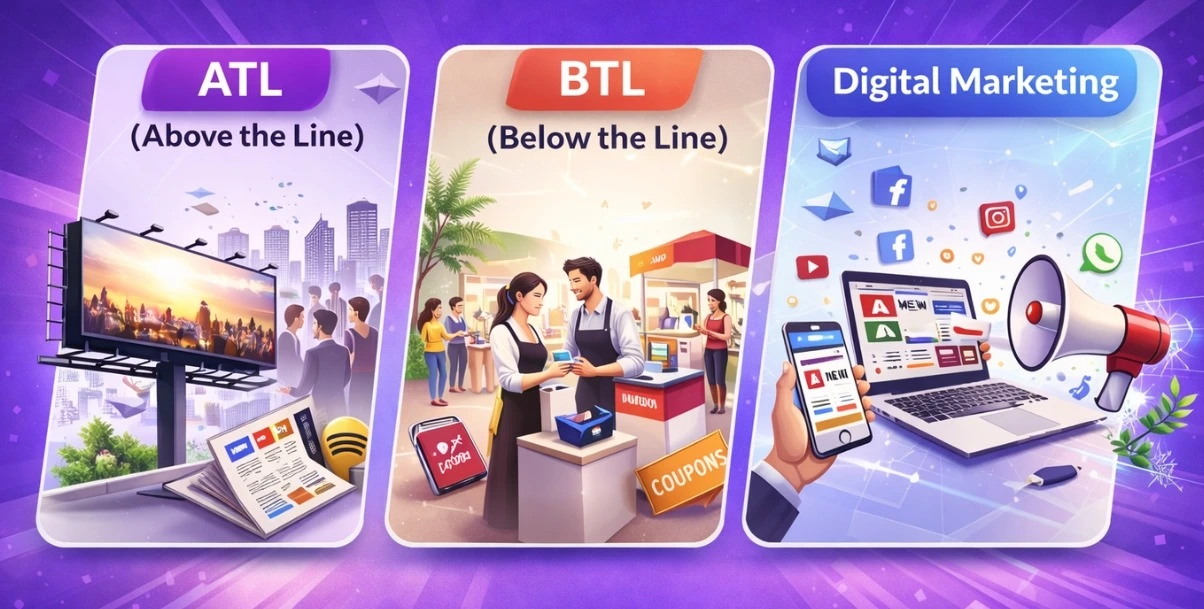
The real power lies in integration.
Brands that treat ATL advertising, BTL Advertising, and Digital Advertising as separate silos often experience inconsistent messaging and fragmented ROI.
An integrated approach ensures consistency across channels while leveraging the strengths of each.
Integrated campaign approach
Consider a product launch example.
Step one: Use ATL advertising to build large scale awareness. Television and outdoor media create initial excitement and establish legitimacy.
Step two: Deploy BTL Advertising in high priority neighborhoods and retail zones. Sampling booths, interactive kiosks, and localized branding create direct experience.
Step three: Amplify everything through Digital Advertising. Run geo targeted ads in areas where BTL activations occur. Retarget viewers who engaged with ATL video content online.
This synergy creates a multiplier effect.
ATL advertising drives curiosity.
BTL Advertising drives engagement.
Digital Advertising drives measurable outcomes.
The integration ensures that customers encounter the brand multiple times across different touchpoints. This increases recall and trust.
For regional campaigns, integration can be even more focused. For example, transit branding supported by society activations and hyperlocal digital campaigns creates a powerful localized dominance strategy.
The key is alignment. Messaging, visuals, and offers must remain consistent across ATL advertising, BTL Advertising, and Digital Advertising.
Common Channel Selection Mistakes
Despite clear benefits, many businesses struggle with channel decisions.
The most common mistake is selecting a channel based on trends rather than objectives.
Another mistake is assuming that Digital Advertising alone can replace every other form of marketing. While it offers powerful targeting, it cannot always substitute the credibility of large scale ATL advertising or the experiential strength of BTL Advertising.
Budget and objective mismatch
Budget allocation without clarity leads to inefficiency.
Some startups invest heavily in ATL advertising before achieving product market fit. This can drain resources without guaranteed returns.
Others overspend on BTL Advertising in areas where their audience is not physically active.
Some brands rely solely on Digital Advertising without building long term brand equity through broader visibility.
The solution lies in objective driven budgeting.
If the objective is mass brand awareness across multiple cities, ATL advertising deserves a significant share.
If the objective is localized penetration in specific pin codes, BTL Advertising should be prioritized.
If the objective is direct sales with measurable ROI, Digital Advertising must take the lead.
Another mistake is ignoring financial forecasting. Marketing spends must align with projected revenue and cash flow realities. Without financial discipline, even well designed campaigns can strain working capital.
This is where strategic financial oversight becomes critical.
Conclusion: Strategy Over Channels
The debate between ATL advertising, BTL Advertising, and Digital Advertising should not be framed as a competition.
Each channel serves a unique purpose within a structured growth strategy.
ATL advertising builds scale and credibility.
BTL Advertising builds connection and physical engagement.
Digital Advertising builds measurable performance and optimization.
The brands that win are those that integrate all three with clarity of objectives, disciplined budgeting, and consistent messaging.
However, channel selection and budget allocation are not just marketing decisions. They are financial decisions that impact profitability, cash flow, and long term valuation.
If your business is scaling and you want to ensure that marketing investments align with sustainable growth, it may be time to explore strategic financial leadership.
Consider evaluating Virtual CFO services to bring structured financial planning, ROI tracking, and budget optimization into your marketing strategy. When marketing and finance work together, campaigns become investments rather than expenses.
The right mix of ATL advertising, BTL Advertising, and Digital Advertising, supported by strong financial oversight, can transform how your brand grows in competitive markets.
Share
Trending Topics
-
 February 13, 2026
-
 February 07, 2026
What Is BTL Marketing in 2026? Formats That Drive Results
Siddharth Prasad
A detail-obsessed operator with a sharp execution mindset, driving consistency, coordination, and on-ground excellence across complex business workflows.