
The first guests to reach a recreated Raichand House in Mumbai on December 1 will have to clear a tongue twister before they are let in. Inside wait the double staircase, the crystal chandelier and Poo's closet from Kabhi Khushi Kabhie Gham, a film that marks 25 years this season. Only 180 spots exist across six days, and the visit is free. Yet Airbnb's invitation drew coverage across India's trade and consumer press within days, and "raichand house airbnb" reached the Google Trends trending list for India.
That is experiential marketing in India at its most compact: a small room built for a very large audience. If you plan on-ground activations, the lesson is to plan the invitation, the visit and the content as one job. This guide takes the Raichand House apart and turns it into a plan you can run in a mall, a gated community or a store.
Key Takeaways
- Plan for the audience that never attends. Airbnb built a free, 180-spot visit, but its value lies in the national attention around it, so design the invitation and content as carefully as the room.
- Use nostalgia only where it sits next to your product. A home-sharing brand opening a famous home fits. A borrowed memory with no link to what you sell is remembered without the brand.
- Script the visit as five or six small moments. Make each easy to photograph and give it a brand cue, from a challenge at the door to a keepsake.
- Measure beyond footfall. Track requests against capacity, branded search, earned coverage and content reuse. Only 42% of Indian marketers measure ROI holistically, according to one survey.
Planning an experience people will line up for? Talk to BajuGali about building it on the ground.
Case facts come from the linked reports, and the advice is our own view as an on-ground BTL team. Airbnb has published no results, so we judge the design only. BajuGali did not work on any case described here.
Last updated: November 26, 2026
In This Guide
- The Raichand House is a 180-guest activation built for a national audience
- Experiential marketing in India has the budget and the demand, but many brands lack a method
- Nostalgia marketing builds your brand only when the memory belongs next to your product
- Design the visit as five or six moments, not one impressive room
- Scarcity and clear rules make a free experience feel valuable
- Measure the experience by what it sets off, not by footfall
- How we would build a Raichand-style experience at your scale
- What happens next
- Frequently asked questions
The Raichand House Is a 180-Guest Activation Built for a National Audience
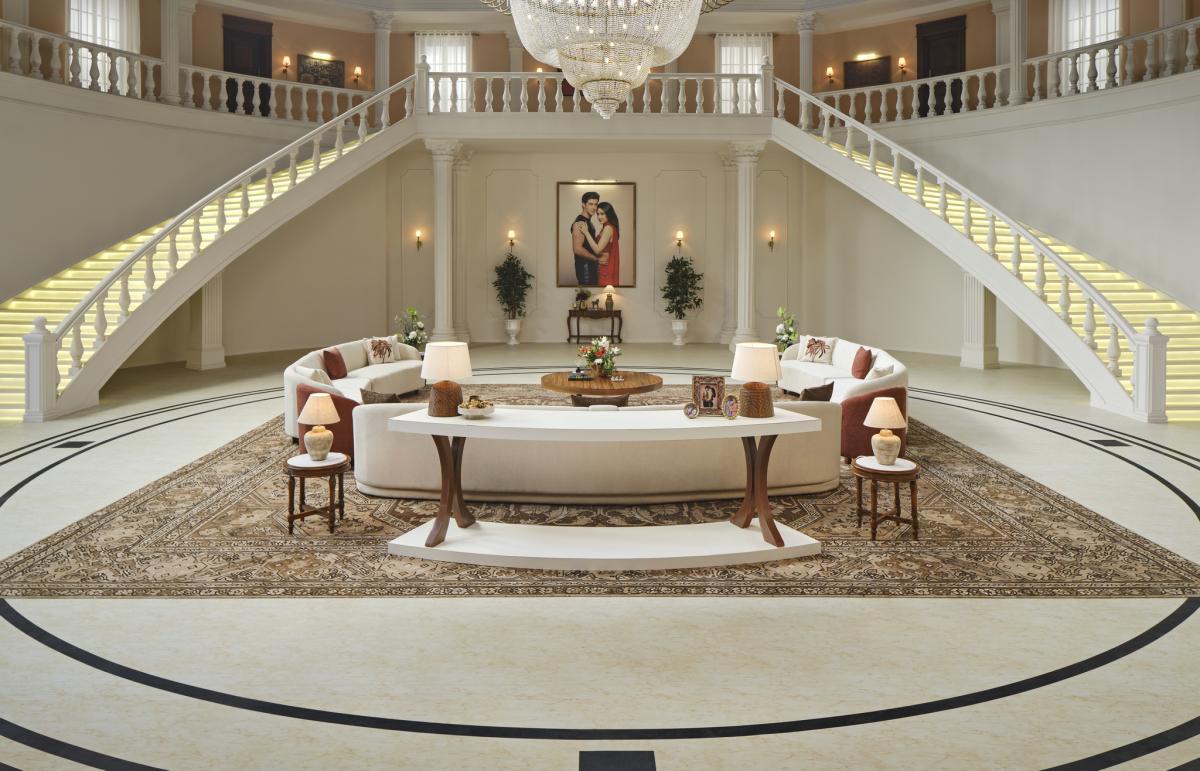
Image: Airbnb Newsroom. Click to read the full report.
The room holds 180 people over six days, and the campaign was built for everyone else. Airbnb's announcement says guests are welcomed in Mumbai from December 1 to 6, 2026, and that booking requests opened on November 23. Guests may book up to two spots. The price is Rs 0, guests pay their own way to Mumbai, and Karan Johar, Poo and Rohan do not appear. Bookers need an active Airbnb profile with positive reviews and a government ID.
Around that small room sits a large campaign. As Social Samosa described it, the campaign film brings back Kareena Kapoor Khan as Poo and Hrithik Roshan as Rohan, with Rohan suggesting that the mansion should open its doors to guests.
Storyboard18, which carried the news on November 19, names Dharma Productions as the partner. If your experience has a partner, plan its audience and channels into your reach from the start.
The search data agrees. Our reading of Google Trends for India on November 26 lists "raichand house airbnb" among the past week's trending searches, at more than 10,000. Every rising "airbnb" query in India that week was about the Raichand House.
On our arithmetic, 180 spots over six days is about 30 guests a day. A room that small only pays back if the many can see it. Before you pick a venue, write down two audiences, the few who will attend and the many who must hear about it, and give each a target.
Experiential Marketing in India Has the Budget and the Demand, but Many Brands Lack a Method
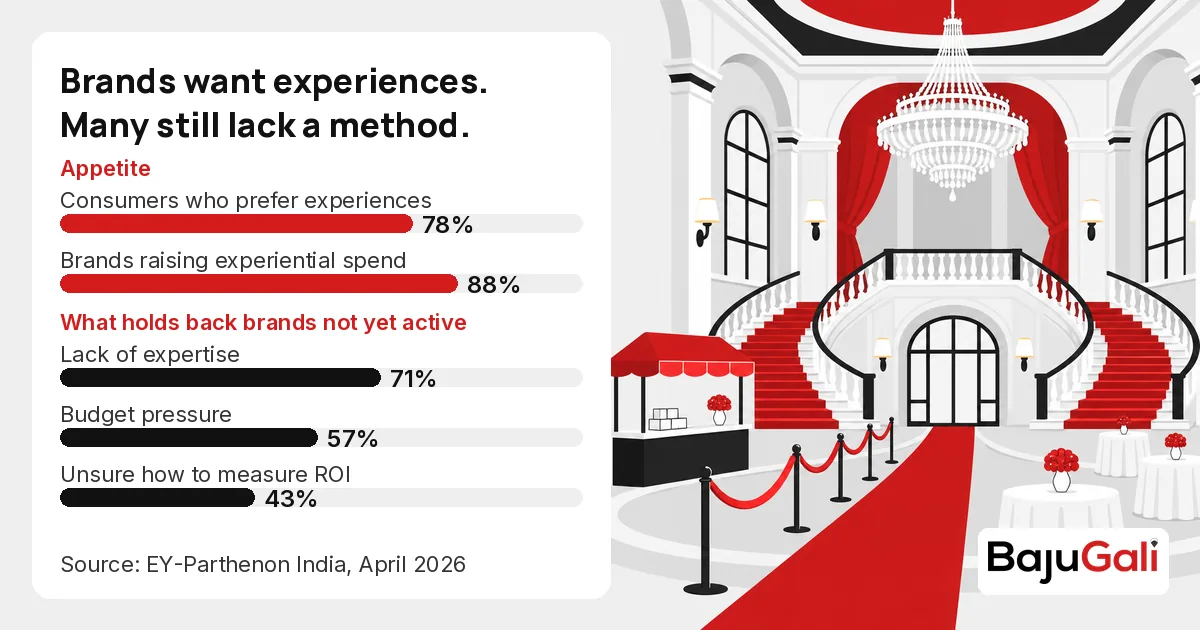
The money and the appetite are there. EY-Parthenon India estimates India's live events market at about Rs 13,000 crore in 2025 and says global experiential spending has crossed USD 130 billion. EY also reports that 78% of consumers prefer experiential interactions with brands and that 88% of surveyed brands are raising experiential spend.
The gap is method. Among brands not yet active, EY reports that 71% point to a lack of expertise, 57% to budget pressure and 43% to uncertainty about measurement and ROI. EY reads these mostly as problems of execution.
A survey of 1,200 marketers, reported by Everything Experiential on November 3, found that 94% of Indian marketers expect to spend more on sponsorships and events over the next 12 to 24 months, but only 42% measure ROI holistically. The article does not name the survey's publisher, so treat the figures as indicative.
For the format options, see our guide to BTL marketing in 2026. Before anyone sketches a set, write the objective, the audience and the measure on one page.
Nostalgia Marketing Builds Your Brand Only When the Memory Belongs Next to Your Product
Nostalgia helps a brand only when the memory sits next to what it sells, and a home-sharing brand opening a famous home passes that test. Storyboard18's analysis of November 24 opens with this campaign and lists other recent nostalgia plays, such as Goibibo with Kareena Kapoor Khan as Geet from Jab We Met and ACKO bringing back Munna Bhai and Circuit. Both are advertising campaigns. Kshitij Kaushik, founder of The Germ, argues that nostalgia works when it fits the brand naturally, as Airbnb's link with the film does.
Venu Gopal Nair, CEO of Ideascape Communications, names the risk in one line: "We are overcorrecting for attention and undercorrecting for repeatability." He also warns that if people remember the celebrity or the story but not the brand, the exercise has failed.
Ask three questions before the brief goes out:
- Does the memory sit next to what we sell? Airbnb sells stays in homes, so opening a famous home fits.
- After the visit, can a guest say what we do? If guests remember the set but not the brand, the memory did the work.
- Do we own or license the memory? Without film or music rights, use your own history: an old pack, an old store counter, a jingle customers still hum.
If you do own a property, our concert marketing guide looks at brands that own the stage. Run the fit test on your idea before any money goes into a build.
Design the Visit as Five or Six Moments, Not One Impressive Room
In an immersive brand experience, guests remember what they did inside. Airbnb's announcement lists the visit as a sequence: an entry test, a traditional Raichand-style welcome, the grand staircase and interiors, an immersive audio tour of the living room and family study, Poo's recreated closet with mirror moments, a note to someone special, and a keepsake to take home.
Design Pataki's description of the set adds the detail: a hall with a crystal chandelier and a sweeping double staircase, a study with a colonial fireplace and Poo's pink room. The film's interiors were sets built in Mumbai, so this is a recreation of those interiors. For your own build, copy the few details guests already know by heart and spend less on the rest.
The last column is our own suggestion for a mall, a community or a store.
| Moment | What Airbnb does | Our suggestion at your scale |
|---|---|---|
| Entry challenge | A tongue twister tied to Rohan must be cleared to enter | A quick quiz or a product-fact game at the door |
| Welcome | A traditional Raichand-style welcome | A consistent greeting from trained brand ambassadors |
| Guided walk | An immersive audio tour of the living room and study | A short audio or ambassador-led walk through three zones |
| Hero frame | The grand staircase and Poo's closet with mirror moments | One backdrop built for photos, with a brand cue in view |
| Personal act | Guests write a note to someone special | A message card or pledge wall guests can post or take away |
| Keepsake | A keepsake to take home | A small branded item guests will keep or use |
Storyboard the visit minute by minute, mark one photo frame per moment, and put a brand cue in each frame. For more formats that work in stores and malls, see our live brand activation examples.
Scarcity and Clear Rules Make a Free Experience Feel Valuable
A free experience can feel cheap unless it behaves like a scarce one, and Airbnb's rules do that work. The spots are capped, guests must request one, the dates are fixed, and the conditions, including what the visit leaves out, are printed on the page. Clear limits make an offer feel real and head off disappointment.
Hindustan Times asked how Airbnb would choose its 180 guests, so the selection method is part of the story. If you run a limited experience, decide how you will pick guests and say so on day one.
A Teaser Before the Reveal: Generali's Carter Road Cube

Image: afaqs. Click to read the full report.
Anticipation matters as much as the visit. afaqs reported on November 19 that Generali Central Life Insurance unveiled a large Rubik's Cube installation on Mumbai's Carter Road after a build-up around a mystery gift box, paired with an online Dreams Wall where people write an aspiration and pledge a step.
EY frames a good experience as three stages: anticipation, participation and amplification. Plan the third for the people who never walk in. A reel, a virtual walk-through or a follow-up in another city carries the experience to them, and creators can carry it too. Our sister site TrendLabs looks at where brand money in the creator economy is going. Publish capacity, selection rules, inclusions and dates on day one, and plan a content route for everyone who does not get in.
Measure the Experience by What It Sets Off, Not by Footfall
For a 180-spot experience, footfall is the least useful number, because it was capped before anyone arrived. EY's view is that brands should look past impressions and footfall to emotional resonance, advocacy and long-term brand memory. Airbnb has published no request counts or costs, so nobody outside the company can say yet whether the Raichand House worked.
What outsiders can see is the shape of attention. In our Google Trends reading, searches for "raichand house" in India peaked on November 19 and 20 and had faded to a small level by November 26. A brand can watch the same curve: a burst of branded search at the announcement, then a tail to extend with content.
Judge a small-capacity experience on six counts:
- Requests against capacity. Count every request, including the ones you turn down.
- Branded search. Compare the weeks around the announcement with the weeks before.
- Earned coverage. Count the articles and posts you did not pay for.
- Content reuse. Track how often guest photos and your footage run in paid and owned channels.
- Leads or sign-ups at the venue. Capture them with consent.
- Cost per engaged guest. Divide build and running cost by guests who completed the visit.
Set baselines two weeks before the announcement, so the lift can be read when it comes.
How We Would Build a Raichand-Style Experience at Your Scale
This is how we would approach a set-style brand experience in a mall, a community, a corporate park or a store:
- 1. Pick the memory your brand can own. Use your product's history, a city ritual or a property you hold rights to, and run the fit test.
- 2. Clear rights and permissions early. That means license terms, venue approval, local permissions and fire and crowd safety.
- 3. Choose a venue that matches the audience. A mall atrium, an IT park lobby, a clubhouse or your own store can work if you manage capacity in time slots.
- 4. Build one hero frame and four or five smaller moments. We would fabricate them as modular pop-up and temporary structures that can travel to a second city.
- 5. Open requests with clear rules. State the selection method and use hyperlocal distribution to invite the catchment.
- 6. Capture and measure. Collect content with consent and read results against your baselines.
What Happens Next
The visits run from December 1 to 6, so the next thing to watch is what guests post and whether Airbnb shares any results. If Airbnb publishes request numbers, read them against the 180 spots, because that ratio shows how much demand a small room can create. Licensed characters are also reaching live stages, and BookMyShow Live's Peppa Pig tour starts in January. Nostalgia will be crowded this season, so the brands that stand out will tie the memory to the product. Before the creative brief goes out, choose the memory you can own, run the fit test, and lock a first-quarter 2027 window with a venue, a capacity and a baseline.
Plan an Experience With BajuGali
If you are planning a brand experience for early 2027, BajuGali plans and runs on-ground brand activations across malls, gated communities, corporate parks, stores and street markets, and builds activation kiosks, stalls and pop-up structures. If you are choosing a brand activation agency for the next quarter, talk to our team about your experience and we will help you shape the idea and the plan.
Plan Your ExperienceFrequently Asked Questions
What is experiential marketing?
Experiential marketing means immersive, participatory brand interactions instead of one-way advertising, as EY describes it. In India, EY reports that 88% of surveyed brands are increasing experiential spend and that 78% of consumers prefer these interactions. Examples range from a mall activation to a recreated film set.
What is Airbnb's Raichand House experience?
It is a free, two-hour visit to a recreated Raichand House from Kabhi Khushi Kabhie Gham in Mumbai, from December 1 to 6, 2026. There are 180 spots, booking requests opened on November 23, and the film's stars do not appear in person, according to Airbnb's announcement.
How do you measure an experiential marketing campaign?
Look beyond footfall. Track requests against capacity, branded search lift, earned coverage, user content and leads, against baselines set before launch. Only 42% of Indian marketers measure ROI holistically, per a survey of 1,200 marketers reported by Everything Experiential, so a clear baseline is a good start.
Does nostalgia marketing work for brands in India?
It works when the memory fits the product, as with Airbnb opening a famous home. Industry voices quoted by Storyboard18 warn that people may remember the film or celebrity and forget the brand. Check the fit, secure the rights and make sure guests can say what you do.
Related Reading
Share
Trending Topics
-
 November 24, 2026
Concert Marketing in India: How Brands Turn Live Music Into BTL
-
 November 21, 2026
Wedding Season Marketing in 2026: BTL Ideas for 52 Lakh Weddings
-
 November 19, 2026
GTA 6 Marketing: How Rockstar Turned Real Cities Into Vice City
-
 November 17, 2026
Chhath Puja Marketing in 2026: How Brands Took BTL to the Ghats
-
 November 15, 2026
Brand Activation in India: 4 Live Examples and What They Teach
-
 February 13, 2026
ATL vs BTL vs Digital Advertising Explained for Smart Budget Allocation
-
 February 07, 2026
What Is BTL Marketing in 2026? Formats That Drive Results
Siddharth Prasad
A detail-obsessed operator with a sharp execution mindset, driving consistency, coordination, and on-ground excellence across complex business workflows.