Brand activation in India works when a campaign gives people something to do as well as something to look at. Four campaigns covered by the trade press in November 2026 show how. Xiaomi put Santa Claus in a mall store, Fujifilm instax handed out instant prints at malls, Zepto and Philips steamed a real lehenga on a billboard, and PharmEasy sent a life-sized sugar cube into public spaces with a QR code.
Planning an activation? Talk to our activations team.
Each campaign gets its own section, followed by what they share and a checklist for planning your own. Campaign facts come from the linked trade coverage. The planning advice is our own view as an on-ground BTL team.
Last updated: November 15, 2026
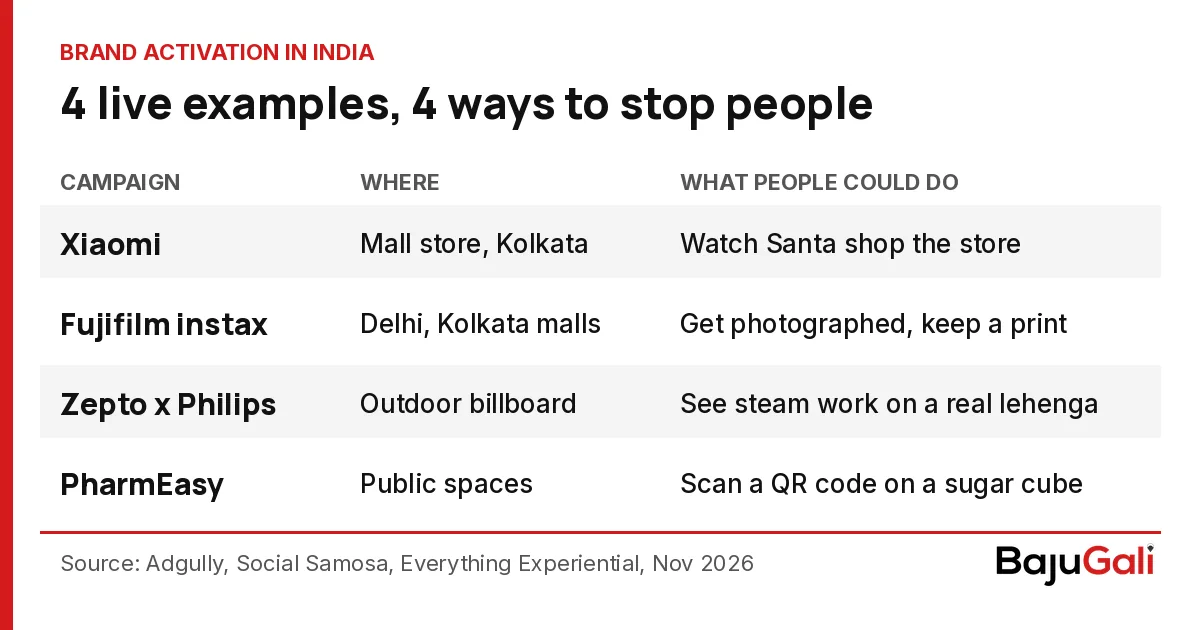
The same comparison as text, with sources and the move each campaign shows. The moves are our own Stop, Try, Take, Trace checklist, explained below.
| Campaign | Where | What people could do | Moves shown | Source |
|---|---|---|---|---|
| Xiaomi with Tribes Communication | Mall store, Kolkata | Watch Santa shop the store | Stop | Adgully |
| Fujifilm instax with Times One | Malls in Delhi and Kolkata | Get photographed and take home an instant print | Try, Take, Trace | Social Samosa |
| Zepto and Philips | Outdoor billboard | Watch steam work on a real lehenga | Try | Everything Experiential |
| PharmEasy | Public spaces | Scan a QR code on a sugar cube character | Stop, Take, Trace | Everything Experiential |
In This Guide
- What is brand activation, and why does it matter right now?
- What was the idea behind Xiaomi's Santa activation?
- How did Fujifilm instax use mall visits during Durga Puja?
- What makes the Zepto and Philips billboard different?
- How did PharmEasy link a street character to a QR code?
- What do the four campaigns have in common?
- How should a brand plan a BTL activation in India?
- Which mistakes should brands avoid?
- Key takeaways
- Frequently asked questions
What Is Brand Activation, and Why Does It Matter Right Now?
Brand activation is any marketing effort that gets a person to take an action with a brand: try a product, pose for a photo, scan a code, walk into a store. It sits inside below-the-line marketing, which we explain in our guide to BTL marketing formats in 2026. We treat experiential marketing as the part of activation where the action is a memorable experience, such as a live demo or an installation.
Adgully, covering the Xiaomi campaign, describes a festive season packed with promotions and competing brand messages. In that clutter, an on-ground idea gives people a reason to stop. Three of the four campaigns below are festive and the fourth is a health awareness drive. All four move the message into a place where people can see, try or keep something.
What Was the Idea Behind Xiaomi's Santa Activation?

Image: Adgully. Click to read the full report.
Xiaomi worked with Tribes Communication to bring Santa Claus to its South City Mall store in Kolkata, according to the Adgully report from November 12, 2026. Santa played a Diwali shopper. In his red suit, he loaded a trolley with Xiaomi products across phones, audio, wearables, tablets and TVs. The joke was that the festive offers were good enough for even Santa to start his Christmas shopping early.
The idea sat at the point of purchase, where shoppers were already deciding. The offers were carried by a story, which Adgully describes as going beyond simply communicating deals. The trolley also put a wide slice of the product range in one visual. Adgully reported no footfall or sales numbers, so the coverage describes the idea, with no results to judge it by.
How Did Fujifilm instax Use Mall Visits During Durga Puja?

Image: Social Samosa. Click to read the full report.
Fujifilm instax took its instant cameras to Select Citywalk in Delhi and South City Mall in Kolkata during Durga Puja. The activation, conceptualized by Times One, had photo opportunities, instant prints that visitors took home and a showcase of the product range, per the Social Samosa case study from November 9, 2026. The campaign also reached beyond the malls: influencer content on the malls' own digital platforms, promoting their Durga Puja pandals, featured the brand.
In our view, a visitor who leaves with a photo carries the brand home and has a reason to remember where it came from. Receiving the print on the spot also worked as the demonstration, since the product's promise is a picture in your hand within seconds. The case study lists two cities, two malls and several engagement formats as results, with no sales or conversion data.
What Makes the Zepto and Philips Billboard Different?
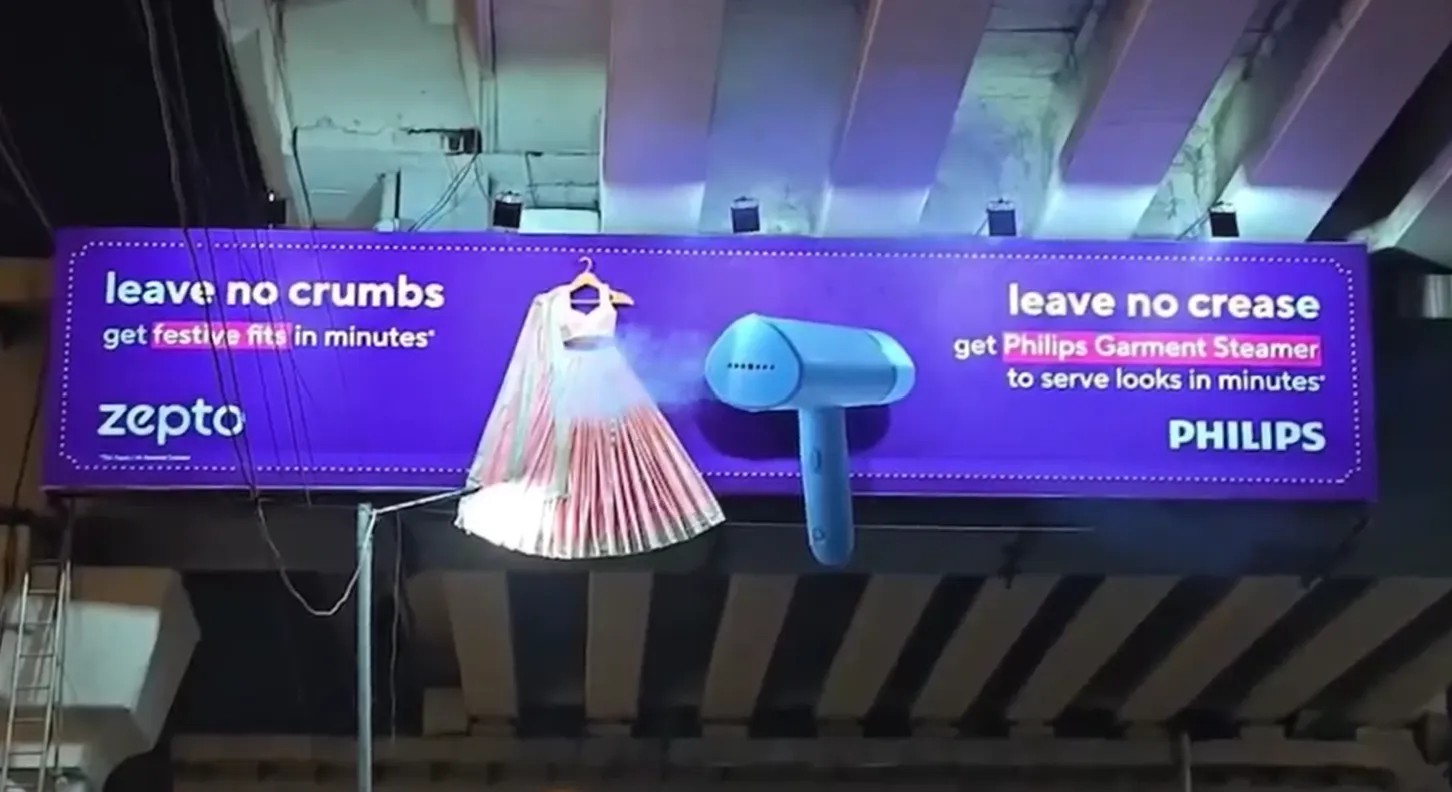
Image: Everything Experiential. Click to read the full report.
Zepto and Philips built an outdoor display around a real lehenga and a working Philips Garment Steamer steaming the outfit in public view, as Everything Experiential reported on November 10, 2026. Zepto's side of the board promised festive outfits in minutes. Philips promised to serve looks in minutes. The shared line was "Leave no crumbs. Leave no crease."
The board shows the product doing its job in front of passersby, which in our view is a stronger claim than a product photo. It is also a partnership: two brands with related festive needs sharing one board and one idea. Outdoor media usually counts as ATL, but this one behaves like BTL because the billboard performs a live demonstration.
How Did PharmEasy Link a Street Character to a QR Code?
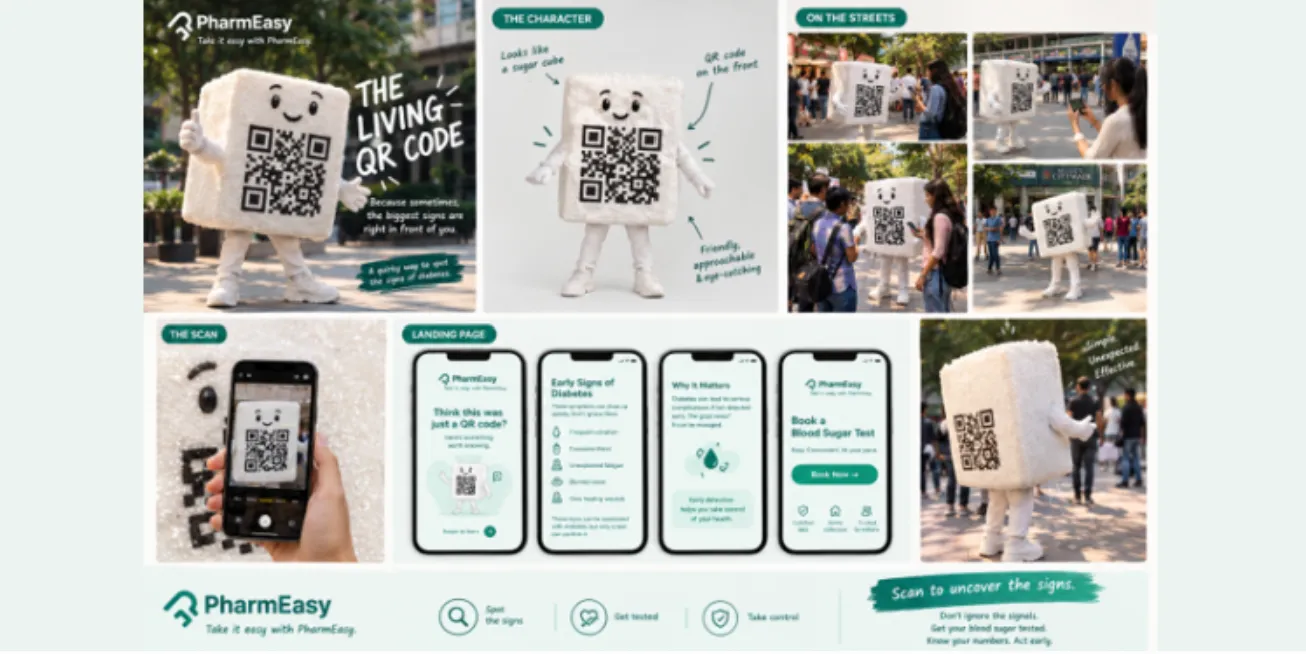
Image: Everything Experiential. Click to read the full report.
For World Diabetes Day, PharmEasy sent a life-sized sugar cube character through public spaces carrying a scannable QR code, per Everything Experiential on November 14, 2026. Passersby could scan the code to read about early symptoms of diabetes, and the campaign closed by encouraging people to book a blood sugar test.
PharmEasy's campaign sits outside the festive calendar. The format still carries over to any category where a person needs a reason to stop. The character gets attention. The QR code keeps the conversation going after the moment passes, and it gives the team a number to count: scans. The coverage did not publish scan figures, but the format makes them easy to collect.
What Do the Four Campaigns Have in Common?
Set side by side, each campaign shows at least one of four moves we call Stop, Try, Take, Trace. The labels are our own shorthand, useful as a checklist, and the table above marks which move each campaign shows.
Stop is a surprise that interrupts a busy crowd, like Santa shopping or a walking sugar cube. Try means people use the product or watch it work up close, like steam on a lehenga. Take means the person leaves with something, whether a print or a link on their phone. Trace means there is a way to count what happened, such as scans, prints, redemptions or footfall.
None of the four reports published footfall, scan or sales figures. The PharmEasy QR code and the instax prints are the clearest built-in counts. Missing numbers are common in trade coverage in our experience, so close that gap before launch.
How Should a Brand Plan a BTL Activation in India?
Five planning decisions build on that checklist. Each one answers a question your team should settle before the budget is approved.
- Choose the place first. Pick a location where people already have time and intent: a mall, a gated community, a store or a market street. Our activations service covers each of these.
- Write the idea in one line. If you cannot say it in a sentence, such as "Santa shops early", passersby will not grasp it in seconds either.
- Design the take-home. Decide what each person leaves with: a sample, a print, a coupon, a QR link.
- Fix the count. Name the one number that defines success and make the activation produce it.
- Plan the digital tail. Fujifilm instax used the malls' influencer content to extend its reach, so decide where the on-ground moment continues online.
Three checks matter in India, drawn from our own on-ground work. Get permission from the venue owner before the creative is locked: mall management for a mall, the residents' association for a gated community, the civic or police office for a street, and confirm it in writing. Brief promoters in the local language of each city. Match the launch to the local calendar, as these campaigns were tied to Durga Puja, Diwali and World Diabetes Day.
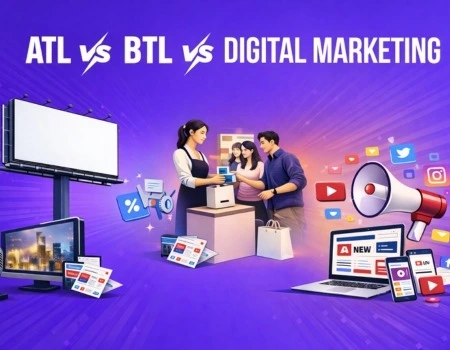
For help choosing between ground, outdoor and digital spend, read our ATL vs BTL vs digital budget guide.
Which Mistakes Should Brands Avoid?
These are the errors we watch for when reviewing an activation plan.
- A stall that carries a logo but asks visitors to do nothing.
- No take-home: when nothing leaves with the visitor, recall tends to fade quickly in our experience.
- Measurement added after launch, which usually misses the data that mattered.
- Copying an idea without its logic. A Santa gag fits Xiaomi's festive offers but will not suit every brand or season.
- Promoters who cannot explain the offer in one sentence, which wastes the footfall the idea attracted.
Key Takeaways
- Brand activation in India works best when people can see a product in action, try it or take something home.
- Xiaomi, Fujifilm instax, Zepto x Philips and PharmEasy each moved a festive or awareness message into physical space.
- Stop, Try, Take, Trace is a simple checklist for planning: interrupt, let people experience, give them something to keep, and count.
- Published coverage of these campaigns reports no sales results, so build your own measurement into the plan.
Frequently Asked Questions
What is brand activation in simple terms?
Brand activation is any marketing effort that gets a person to take an action with a brand, such as trying a product, posing for a photo, scanning a QR code or visiting a store. The goal is participation beyond exposure, which is why activations usually happen in physical places where people have time to engage.
How is brand activation different from experiential marketing?
Experiential marketing is the part of brand activation where the action is an experience the person remembers, such as a live demo or an installation. Brand activation is the wider term and also covers simpler actions like sampling or a coupon scan. In practice the two overlap heavily, and many campaigns blend them.
Is brand activation part of BTL marketing?
Yes, most brand activations are BTL, or below the line, because they reach people directly in a specific place and time, such as a mall, a gated community or a street. Some activations, like a live outdoor billboard, sit on the border between ATL and BTL because they use outdoor media to stage a live demonstration.
How do you measure a brand activation?
Decide the count before launch. Useful measures include QR scans, instant prints or samples handed out, coupon redemptions, leads captured, store footfall and social posts from participants. Pick one primary number that matches the goal, then track the others as support, so the budget discussion starts from a planned count.
Talk to BajuGali About Your Activation
If you are planning an on-ground campaign for the next season, start with the place, the one-line idea and the number you will count. BajuGali plans and runs on-ground brand activations across malls, gated communities, corporate parks, stores and street markets. Talk to our team about your activation and we will help you shape the idea and the plan.
Discuss Your ActivationRelated Reading
Share
Trending Topics
-
 November 15, 2026
-
 February 13, 2026
ATL vs BTL vs Digital Advertising Explained for Smart Budget Allocation
-
 February 07, 2026
What Is BTL Marketing in 2026? Formats That Drive Results
Siddharth Prasad
A detail-obsessed operator with a sharp execution mindset, driving consistency, coordination, and on-ground excellence across complex business workflows.