
For years, BTL marketing was treated as the “support act” of advertising. Flyers, kiosks, mall promoters, and sampling desks were seen as execution-heavy and strategy-light. In 2026, that perception is not just outdated, it is dangerous for brands that rely only on digital visibility.
As digital advertising becomes more crowded, more automated, and more ignored, BTL in marketing has evolved into one of the most powerful tools for attention, trust, and conversion. When executed strategically, BTL marketing no longer plays a supporting role. It becomes the main driver of demand in high-intent environments.
This blog breaks down what BTL marketing really means in 2026, how it has evolved in India, which BTL activities in marketing actually work today, and how brands should deploy BTL in advertising to drive real business outcomes.
What Is BTL Marketing in Advertising
Definition and meaning of BTL marketing
BTL marketing, or Below The Line marketing, refers to direct, targeted, and experience-driven marketing activities that engage consumers at a physical or hyperlocal level.
Unlike mass media advertising, BTL in advertising focuses on:
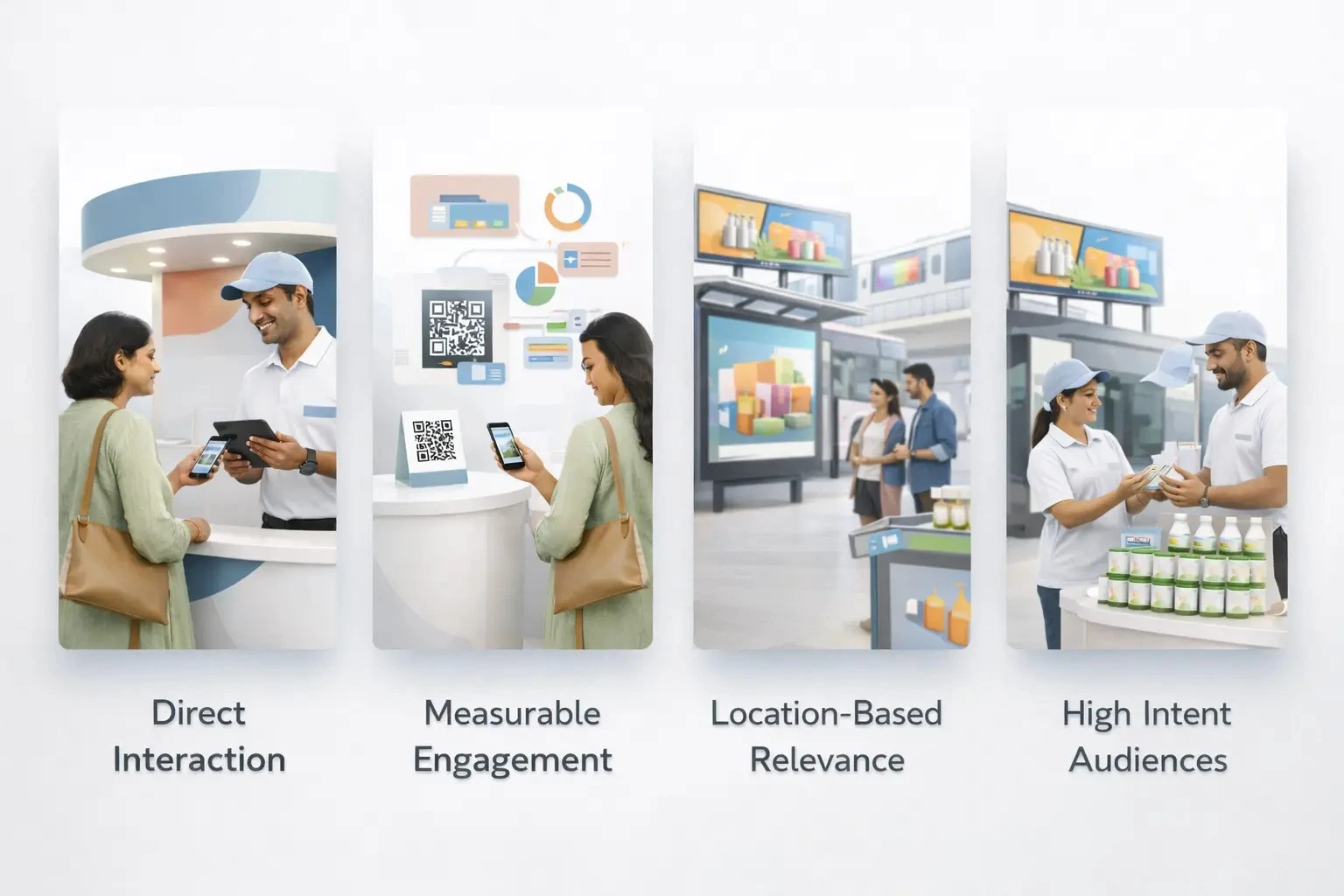
- Direct interaction: Face-to-face engagement with consumers
- Measurable engagement: Actions that can be tracked and evaluated
- Location-based relevance: Messaging aligned to physical context
- High intent audiences: Consumers already open to interaction
In simple terms, BTL in marketing is about meeting the customer where attention already exists, rather than fighting for attention on crowded screens.
In 2026, BTL marketing is defined less by the medium and more by the moment. If a brand is present at the right place, at the right time, in the right context, it qualifies as effective BTL marketing.
Examples include:
- Mall activations
- Society marketing
- Transit branding
- Office park engagements
- Experiential pop-ups
- Campus and corporate activations
The core principle remains unchanged. BTL marketing works best when it feels personal, relevant, and non-disruptive.
Evolution of BTL Marketing in India
How BTL activities in marketing evolved from flyers to experiences
In India, BTL marketing has gone through three clear phases.
Phase 1: Distribution era
Early BTL activities in marketing were largely transactional. Pamphlet distribution, stall setups, door-to-door promotions, and free sampling dominated the space. Measurement was weak and execution was volume-driven.
Phase 2: Visibility era
As malls, IT parks, and gated communities expanded, BTL in advertising shifted toward visibility. Brands focused on kiosks, standees, and promoter-led interactions. While engagement improved, strategy was still secondary.
Phase 3: Experience and intent era
By 2026, BTL marketing in India has fully entered the experience-led phase.
Modern BTL activities in marketing are now designed around:
- Dwell time
- Consumer mindset
- Contextual relevance
- Data capture
- Assisted conversion
A society activation today is not just about distributing flyers. It includes QR-based lead capture, WhatsApp opt-ins, demo experiences, on-ground offers, and post-activation retargeting.
The evolution of BTL in marketing mirrors consumer behavior. People now value real interactions over digital noise.
Key BTL Activities in Marketing That Work in 2026
Activations, society marketing, transit and hyperlocal BTL campaigns
Not all BTL activities work anymore. In 2026, only formats that respect consumer attention and intent deliver results.
Brand activations
Modern activations are not about loud branding. They are about meaningful interaction.
Effective activation elements include:
- Product demos
- Try-before-you-buy experiences
- Guided walkthroughs
- Interactive installations
- Limited-time offers
Activations work best in malls, exhibitions, tech parks, and lifestyle hubs where people already have time and curiosity.
Society marketing
Society marketing has become one of the highest ROI formats of BTL in advertising in India.
Why it works:
- Repeated exposure
- Trust through familiarity
- High family decision involvement
- Community influence
Effective society BTL campaigns include:
- Entry gate branding
- Weekend experience zones
- Kids engagement combined with parent pitching
- Sampling combined with instant offers
- WhatsApp based follow-ups
For categories like real estate, home interiors, education, health, and fintech, society marketing is outperforming digital leads in quality.
Transit and mobility-based BTL
Transit BTL has evolved far beyond bus wraps.
In 2026, transit BTL includes:
- Metro station branding
- Office shuttle branding
- Cab and EV branding
- Airport touchpoint activations
- Parking area engagement
The power of transit BTL in marketing lies in repeated passive exposure. The same consumer sees the brand daily, building recall and trust without ad fatigue.
Hyperlocal BTL campaigns
Hyperlocal BTL focuses on micro-markets instead of cities.
Examples include:
- Market-specific promotions
- Festival-led neighborhood activations
- Local influencer assisted activations
- Area-specific offers
Hyperlocal BTL activities in marketing work especially well for D2C brands, local services, and new category creators.
When BTL Marketing Works Better Than Digital Advertising
High-dwell physical environments vs high-scroll digital platforms
Digital advertising has scale. BTL marketing has attention.
In 2026, the gap between reach and impact has never been wider.
Digital platforms are dominated by:
- Algorithm dependency
- Ad blindness
- Rising CPMs
- Low attention spans
- Passive scrolling
BTL in marketing thrives in environments where people slow down.
- Malls
- Societies
- Offices
- Campuses
- Events
- Airports
In these environments, BTL in advertising delivers:
- Longer engagement time
- Real conversations
- Immediate trust signals
- Higher intent actions
For high-consideration products like real estate, finance, education, healthcare, and premium retail, BTL marketing often outperforms digital ads in conversion quality.
BTL does not replace digital. It strengthens digital performance by creating warmer audiences.
How Brands Should Use BTL Marketing Strategically
Awareness vs acquisition use cases in BTL advertising
The biggest mistake brands make is treating all BTL activities as awareness plays. In 2026, BTL in advertising must be clearly aligned to business goals.
BTL for awareness
BTL awareness campaigns work best when:
- Entering new markets
- Launching new categories
- Building trust quickly
- Reinforcing ATL or digital campaigns
Formats suited for awareness:
- Transit branding
- Entry gate branding
- Event sponsorships
- Large format installations
The goal here is mental availability, not immediate leads.
BTL for acquisition
BTL acquisition campaigns are where most brands underperform due to poor planning.
Acquisition-focused BTL in marketing requires:
- Clear call-to-action
- Trained promoters
- Lead capture systems
- Instant incentives
- CRM integration
Examples include:
- Demo plus offer formats
- Appointment booking kiosks
- QR-based lead forms
- WhatsApp opt-ins
- Assisted checkout experiences
When BTL activities in marketing are designed for acquisition, they often deliver lower cost per qualified lead than digital campaigns.
The Real Power of BTL Marketing in 2026
BTL marketing in 2026 is not about scale. It is about signal quality.
The brands winning today are not choosing between digital and BTL. They are integrating both.
Smart brands use BTL in marketing to:
- Warm up cold markets
- Increase digital conversion rates
- Improve trust
- Shorten decision cycles
- Reduce dependency on algorithms
BTL in advertising is no longer execution-first. It is strategy-led, data-supported, and experience-driven.
Final Thoughts
BTL marketing has grown up.
What once lived in the shadow of mass advertising is now one of the most reliable growth channels when executed with intent and structure.
In 2026, BTL in marketing works when brands stop treating it as ground work and start treating it as a serious performance lever.
The future belongs to brands that understand one simple truth:
People ignore ads.
People remember experiences.
Share
Trending Topics
-
 February 13, 2026
-
 February 07, 2026
What Is BTL Marketing in 2026? Formats That Drive Results
Siddharth Prasad
A detail-obsessed operator with a sharp execution mindset, driving consistency, coordination, and on-ground excellence across complex business workflows.